Guides · October 25, 2026
Daytime vs Nighttime Party: How to Choose the Time That Fits Your People and Your Music
Daytime vs nighttime party, compared as hosting advice: energy curves, neighbour load, how the music arc changes, and which guests each time genuinely suits.
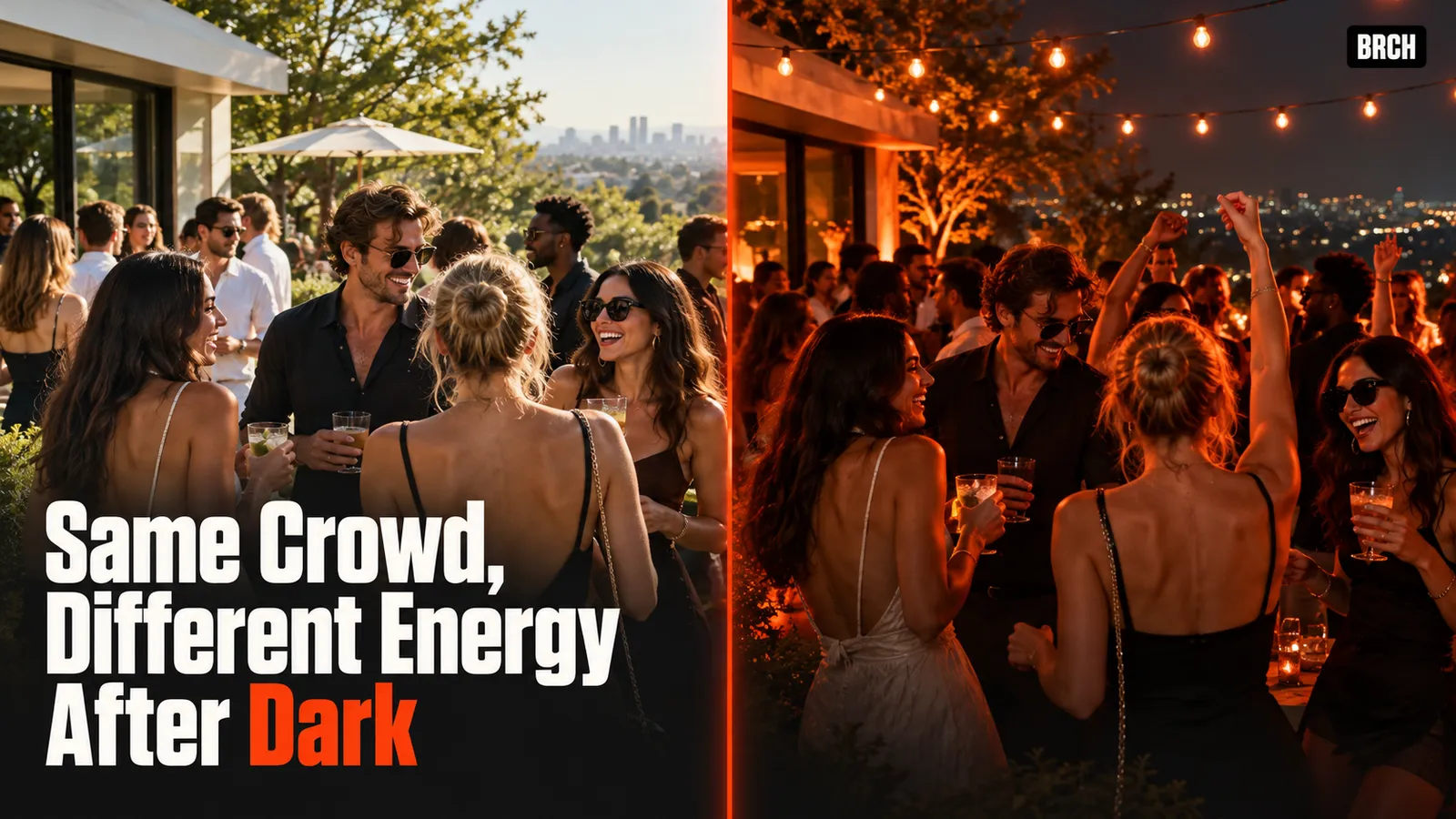
Daytime and nighttime parties are different formats, not the same party at different hours. Daytime runs on sunlight, food, and an honest early peak, suits mixed ages and early schedules, and is kind to neighbours by construction. Nighttime runs on darkness, density, and a late peak, suits a committed crowd, and needs a real closing and transport plan. Advice: choose by your guests and your room first, then program the music arc to the light you have, not the light you wish you had. No venue, price, date, or BRCH edition is claimed in this guide. All guidance is advice, labelled as advice.
Key Takeaways
- Energy follows light. Daytime energy is broad and social. Nighttime energy is focused and intense. Neither is better. They are different goods.
- The neighbour equation flips by time. Daytime noise lands in waking hours. Nighttime noise lands in sleeping hours and needs an end time you keep.
- Music arcs differ. Daytime builds to a late afternoon peak and lands softly. Nighttime builds longer and peaks late.
- Guest fit decides. Work schedules, children, travel distance, and next day duties are format facts, not details.
What daytime does well
Advice: choose daytime when the guest list is mixed in age or energy, when people travel in from distance, or when the next day matters to most of the room. A daytime party includes guests a nighttime party quietly excludes: parents on a schedule, early shift workers, and anyone who loves the people but not the late hours. The day party format, set out in what is a day party, treats an earlier peak and a clean finish as the design, not a compromise.
Daytime energy is wide rather than deep. Advice: plan for conversation, food, and movement between groups as the main events, with music as the room's warmth rather than its sole focus. Sunlight does hosting work for free: people circulate, read faces easily, and settle faster than they do in a dark room. The honest limit is the fade. A daytime party that tries to stretch into a nighttime party without a plan usually gets neither, so give the day its own peak, in the late afternoon, and its own proper ending.
What nighttime does well
Advice: choose nighttime when the point is the music and the room together, when the guest list is a committed crowd, and when darkness itself is part of the format, as it is for themed and dance led nights. Darkness focuses a room. Attention narrows to the sound and the people nearest, the peak can run higher, and the after hours phase, the smaller and steadier end of the arc in how to build a party playlist, has no daytime equivalent.
Nighttime costs more hosting effort. Advice: budget for the parts daylight handles free. Lighting must be made, not found. Food timing matters more, because guests arrive having eaten early or not at all. And the ending is a real responsibility, rides, coats, and guests leaving into the dark, which the party safety guide treats as part of the party rather than an afterthought.
Neighbours and the clock
Advice: be plain about the asymmetry. The same music at the same volume is a smaller imposition at three in the afternoon than at one in the morning, because it lands on waking life in one case and sleeping life in the other. A daytime host mainly manages duration and bass. A nighttime host manages those plus a finish time that must be real, communicated where it matters, and kept when the room would happily continue.
Neither format is neighbour proof by itself. Advice: a long daytime party with outdoor sound can burden a street more than a short, indoor, well closed nighttime one. The format choice sets the starting conditions. The hosting choices, volume, placement, duration, and the kept end time, decide the outcome.
Program the arc to the light
Advice: let the light conduct. Daytime arc: warm up in the late morning or early afternoon as people arrive and eat, build through the social middle of the day, peak in the late afternoon while the light and the room are both full, then land with a softer final hour that lets people leave well. Nighttime arc: warm up longer and lower, because guests arrive from smaller evenings and need the room to gather them, build across the night, peak late, and close with an after hours phase for the committed remainder.
The mistake to avoid is importing one arc into the other slot. Advice: a nighttime arc dropped into the afternoon peaks after most daytime guests have gone. A daytime arc at night lands its peak before the night room has even formed. Match the build length to the format and the party finds its shape with far less host intervention.
FAQ
Which is easier to host? Advice: daytime, for most home hosts. Light, food, and endings are all simpler, and the neighbour load is lighter. Nighttime rewards the extra effort when the format needs darkness.
Can one party do both? Advice: yes, if it is planned as two phases with a hinge, usually the meal or the sunset, where the music, light, and guest list are allowed to change. Unplanned drift from day into night is where both halves weaken.
Which suits a mixed age guest list? Advice: daytime, in most cases. It includes the widest range of schedules and energies without asking anyone to perform being a night person.
Does BRCH run the parties this guide compares? No specific BRCH daytime or nighttime edition, venue, date, or price appears in the record files for this topic, so none is claimed. This guide is general hosting advice comparing two formats.
Sources
- BRCH, "What Is a Day Party? Formats, Timing, and the BRCH Games Days" (brch.life/blog/what-is-a-day-party), read October 25, 2026.
- BRCH, "How to Build a Party Playlist: The Arc of a Night" (brch.life/blog/how-to-build-a-party-playlist), read October 25, 2026.