Guides · October 23, 2026
How to Pick a Party Theme: The One-Sentence Test and the Guest-First Rules
A decision guide for choosing a party theme: the one-sentence test, the wardrobe test, the season test, and how BRCH's proven formats map to different crowds.
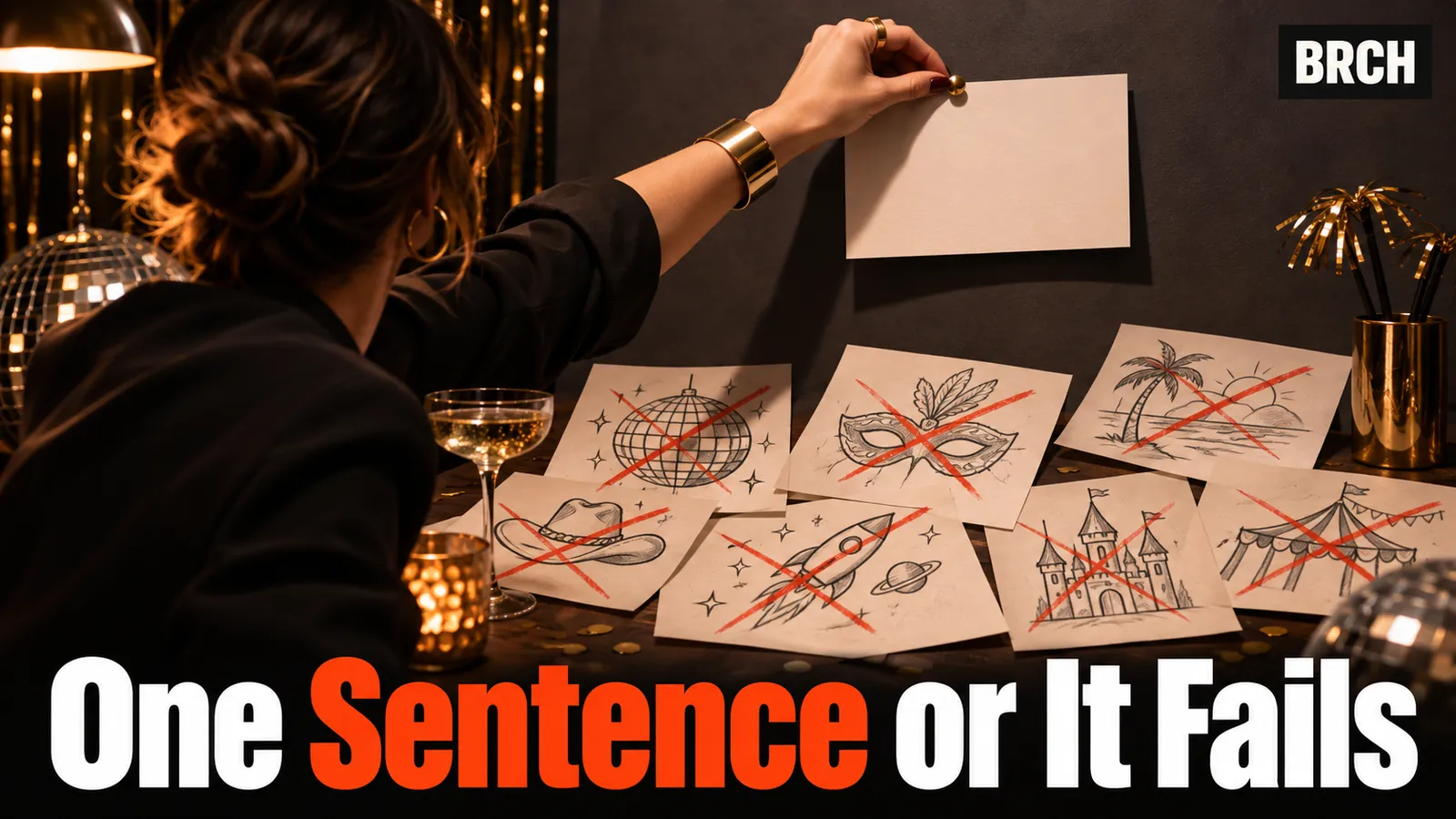
A good party theme passes three tests: it fits in one sentence on the invitation, your guests can dress for it from what they mostly own, and it gives the night at least one activity or moment, not just a look. BRCH's formats all pass: all white, all black, brightest fits, a boat at sunset, a scored pub crawl. This guide applies the tests, then maps crowds to the proven options. Guidance is advice, labelled as advice.
Key Takeaways
- The one-sentence test: if the invitation needs a paragraph to explain the theme, the room will not execute it.
- The wardrobe test: the best themes ask for clothing guests already own, arranged with commitment.
- A theme must decide things: dress, music, and at least one moment of the night. A theme that decides nothing is a color scheme.
- Season is a filter, not a detail: daylight themes in summer, darkness themes in winter.
The one-sentence test
Advice: write the invitation line before anything else. Wear all white. Come as your favorite decade. Dress for a boat at sunset. If the sentence works, guests can start solving it immediately, group chats light up with the right arguments, and the host's later decisions, music, decor, food, inherit a brief. If the sentence needs footnotes, exceptions, and a mood board link, the theme is a wish, not a format. BRCH's White Party has run four editions, more than any other BRCH format, on the strength of the shortest brief in the roster. Brevity is not the whole secret, but it is the gate the secret passes through.
The wardrobe test
Advice: estimate, honestly, what fraction of your list can dress on brief tonight from their own closet. High fractions make generous formats: white, black, color, disco shine, decades. Low fractions make homework formats: specific characters, period accuracy, anything requiring a purchase with a delivery date. Homework formats are not forbidden. They are scheduled differently, with invitations sent early enough for the homework to be fun instead of a fine. The birthday formats guide adds the birthday version of the rule: choose for your least confident guest.
The decision test
Advice: a working theme makes at least three decisions for you. The dress code is one. The music brief is the second: a disco theme hands you the playlist's spine, a black party hands you the heavier end of house, a boat party hands you the sunset arc. The third is a moment: the unmasking at a masquerade, the final of a beer pong bracket, the countdown at New Year's Eve, the group photo a color format begs for. If your candidate theme decides none of these, it is a backdrop. Backdrops are fine for dinners. Parties need engines.
The season and setting filters
Advice: run the survivors through the calendar and the room. Daylight and color themes belong to summer and to the formats in the summer party guide. Darkness and texture themes belong to winter and late hours, the black party register. Water themes need water or they become costumes about water. A theme fighting its setting taxes the host all night. A theme riding its setting feels inevitable, which is the feeling every host is actually buying.
Mapping crowds to formats
Advice, as a short map. A mixed list that barely knows each other: a games format, pub golf or a bracket, because the activity is the introduction. A close group that loves dressing up: a dress code at full strength, white, black, or a silent disco for the group that has done everything. A crowd that loves music more than outfits: a genre or era brief with a costume floor set low. A family spanning list: a day format. The full roster view, with each format's character argued, is in BRCH formats ranked.
FAQ
Can a theme be too much? Yes, when it fails the tests: unexplained in a sentence, undressable from real wardrobes, or decorative only. Too much theme usually means too many requirements, not too strong an idea.
Should I poll my guests on the theme? Poll between two finalists at most. A theme chosen by committee arrives pre-compromised, and the host's conviction is part of what guests commit to.
What if half the room ignores the theme? That is feedback about the tests, not the guests: the brief was unclear, the wardrobe was unrealistic, or the lead time was short. BRCH formats solve it by making the brief one line and the commitment total. Borrow both.
What BRCH facts does this guide rest on? The format roster, event counts, and dates from src/data/formats.ts and src/data/events.ts, including the four White Party editions from 2023 to 2025. All theme advice is labelled advice.
Sources
- BRCH, src/data/formats.ts: formatHubs, read October 23, 2026.
- BRCH, src/data/events.ts: eventsData, read October 23, 2026.